Article
Feb 14, 2026
Why Your Business is Losing Hours a Day (And It’s Not a People Problem)
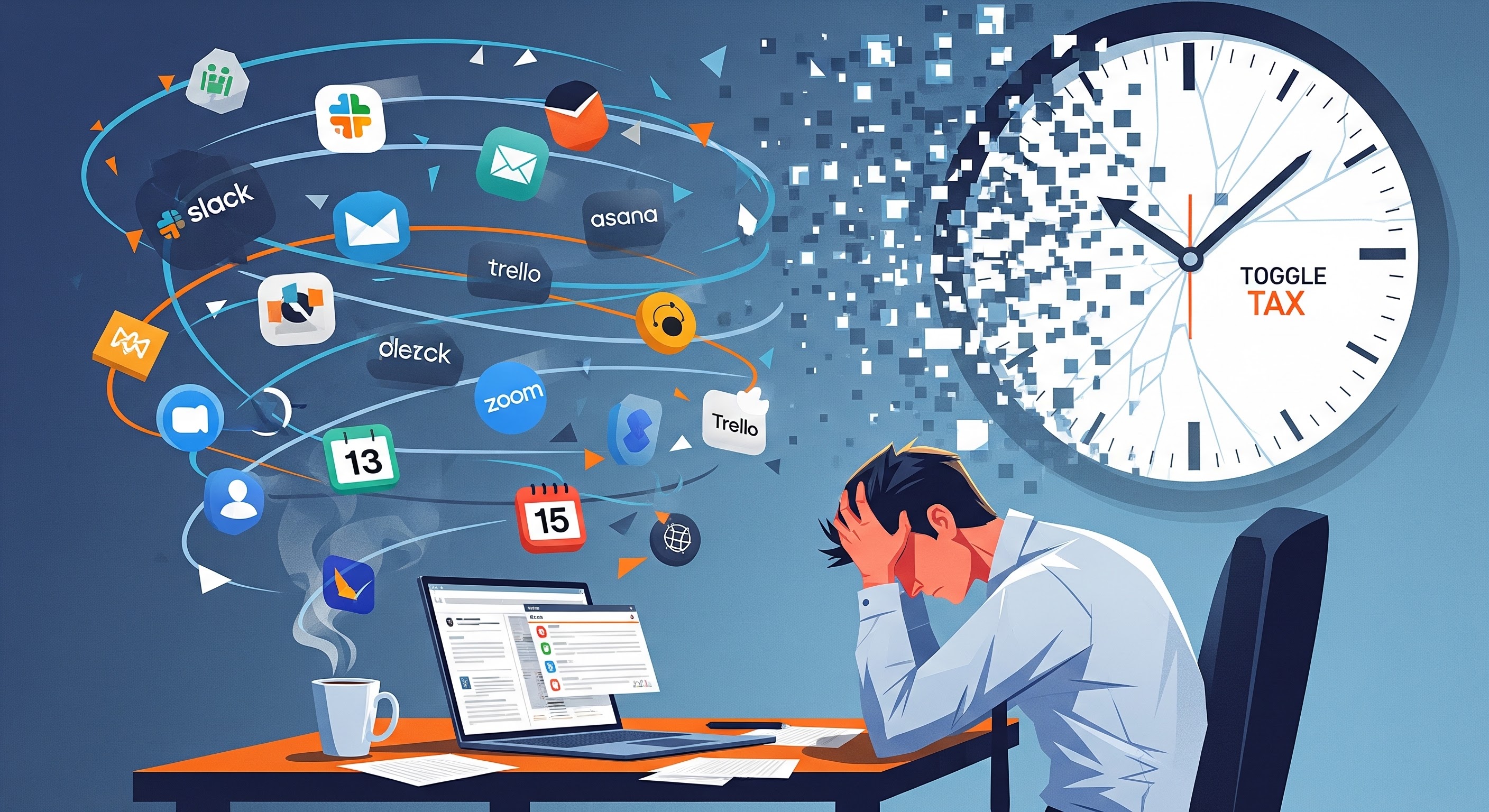
Most CEOs look at a dip in productivity and immediately hunt for a "people problem" to fix or a new piece of software to buy. They are almost always wrong. What they are actually witnessing is an Architecture Problem. Your business is suffering from an invisible profit leak—a structural drain I call the "Toggle Tax." It is quietly sucking over 90 minutes of high-value execution out of every employee, every single day. This isn’t a matter of work ethic or tool features; it’s a failure of the foundational system.
Why Your Business is Losing Hours a Day (And It’s Not a People Problem)
Most CEOs look at a dip in productivity and immediately hunt for a "people problem" to fix or a new piece of software to buy. They are almost always wrong. What they are actually witnessing is an Architecture Problem.
Your business is suffering from an invisible profit leak—a structural drain I call the "Toggle Tax." It is quietly sucking over 90 minutes of high-value execution out of every employee, every single day. This isn’t a matter of work ethic or tool features; it’s a failure of the foundational system.
The "Toggle Tax" is Higher Than You Think
1,200 times a day. That is how often your team is breaking focus.
Research shows the average employee toggles between different applications more than a thousand times per shift. Every time someone jumps from Slack to an email, then over to a project management tool like Monday, they pay the "Toggle Tax." This creates a state of "Information Scavenging"—a critical symptom of structural failure where your team spends more than 10 minutes just trying to locate a specific file, a past client communication, or a standard operating procedure (SOP). If your data is scattered across disconnected platforms, your team isn't working; they are hunting.
Beware of "Attention Residue"
The cost of the Toggle Tax isn't just measured in lost minutes; it’s measured in cognitive bankruptcy. When your brain is forced to switch contexts 1,200 times a day, it creates "Attention Residue"—a persistent mental fog that lingers long after the switch is made.
This residue traps your organization in what we call the Reactive State. In this phase, Slack becomes a "chaos-trap," and vital documents live on "someone’s desktop." High-level execution becomes impossible because your managers are stuck in an endless "Update Loop," asking for status reports because there is no real-time Source of Truth. This is the "Scaling Ceiling": a point where growth no longer increases profit, it only increases the pressure on a broken foundation until the system collapses.
Stop Tinkering and Start Grounding Your AI
Most businesses are currently stuck in "AI Tinkering." They use ChatGPT or Gemini occasionally for general tasks, treating it like a novelty rather than a utility. This is a dead end. To move from the Fragmented State—where tools exist but don't talk—to a scalable operation, you must undergo "Knowledge Consolidation" to build a Private AI Brain.
The value of AI in 2024 and beyond isn't its ability to write a generic email; it’s its ability to navigate your specific business. As the operational diagnostic dictates:
"Stop asking AI general questions. Start asking it your questions, grounded in your private SOPs and data."
By grounding AI in your unique workflows, you can deploy "AI Employees" (Gems). These aren't just chatbots; they are digital workers designed to automate the repetitive context-switching tasks that currently paralyze your human staff.
Your "Work OS" Should Not Be on "Rented Land"
If your data is trapped within siloed, vertical SaaS platforms that refuse to communicate, you are building your business on "Rented Land." This is the hallmark of "SaaS Bloat"—owning a dozen different tools that effectively keep your information hostage.
The solution is to move toward an Integrated Work OS. Rather than adding more fragmented software, you must leverage the ecosystem you likely already own—Google and Gemini—to create a Single Source of Truth. When your communication, data, and AI are integrated into one environment, you stop paying the Toggle Tax and start reclaiming your team's cognitive bandwidth.
Architecture is the New Competitive Advantage
Buying more software to fix a fragmented business is like adding more engines to a plane with broken wings. You don't need more tools; you need a better structure. If you find your business "Underwater"—where growth feels like a threat rather than a victory—you have reached the Architected State requirement.
"The competitive advantage of 2026 isn't the AI you use. It's the architecture you build."
We are entering an era where "AI Architects" are replacing traditional software buyers. These architects don't just shop for features; they build the foundational systems that allow a business to scale without the weight of back-office drag. They turn the back office from a cost center into a growth engine.
Conclusion: Calculating the Cost of Inaction
The math of the 90-minute leak is visceral and unforgiving. To understand the fire burning in your basement, apply this research-backed formula to your current payroll:
(Total Employees) x ($45/hr Avg. Cost) x (30 Hours Lost/Month) = Your Monthly "Toggle Tax"
For most small-to-mid-sized businesses, this figure is a staggering percentage of their annual payroll—money that is currently funding inefficiency rather than innovation.
If your team is underwater, simply working harder won't save them. Is your back office a growth engine, or is the Toggle Tax slowly funding your competitors' success?